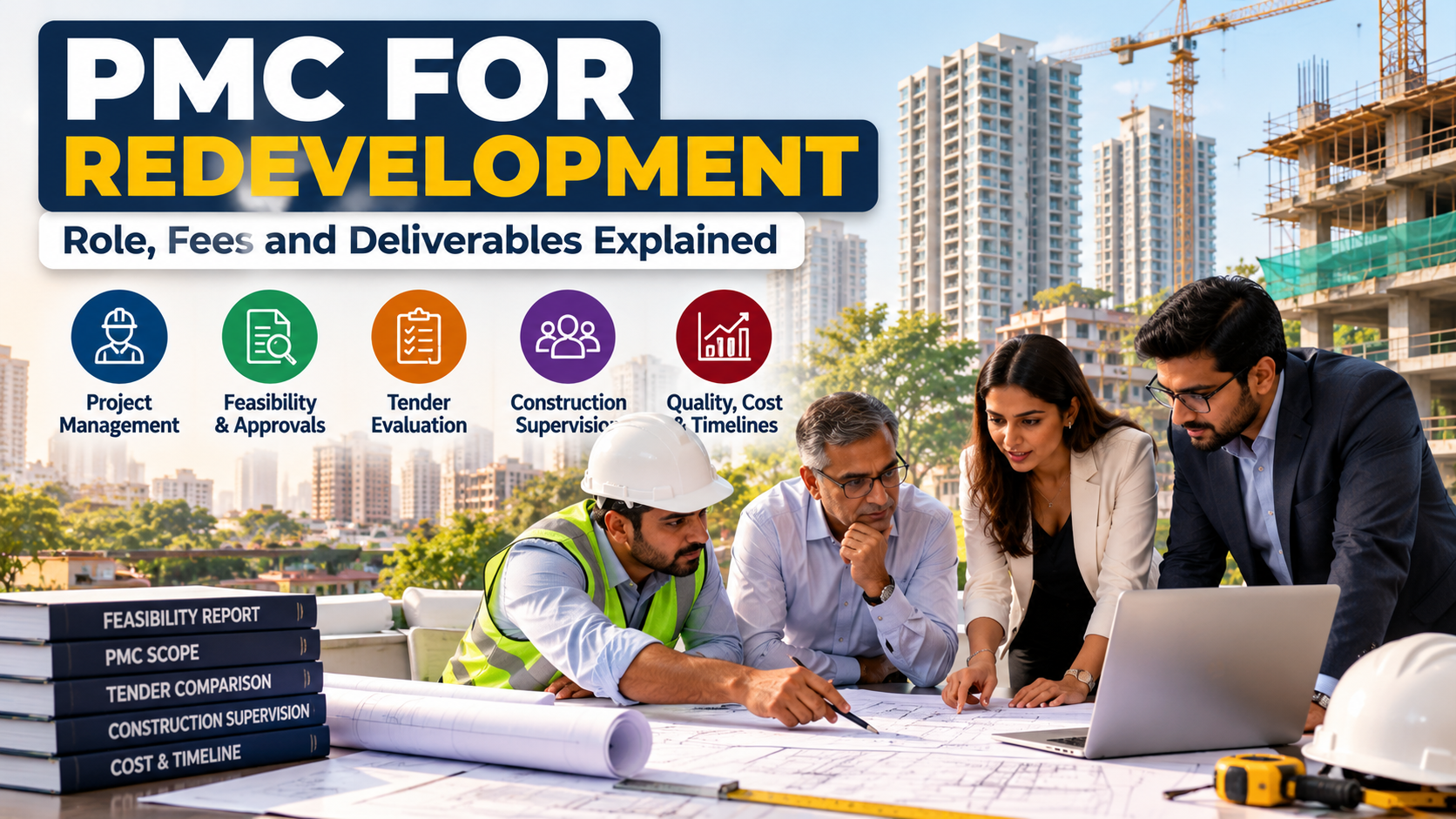
This guide is for housing society committees and members evaluating consultancy services. It explains the consultant's practical scope, not a guaranteed legal outcome or blanket fee quote. For Maharashtra-specific approval and meeting rules, also read SGBM for Redevelopment and Member Consent in Maharashtra Society Redevelopment.
1. What a redevelopment PMC actually does
A PMC for redevelopment is the society's technical and project-management adviser—not the developer's sales representative. A well-scoped PMC engagement protects members during the stages where societies most often lack in-house expertise: feasibility, development potential, tender design, bidder comparison, approvals, construction monitoring and the final handover.
There is no universal India-wide PMC licensing or appointment formula that covers every redevelopment. The role must be defined against the site's governing law, the society's ownership and the project agreement. In Maharashtra cooperative housing society redevelopment, the updated 30 September 2026 directions establish a documented pathway for selecting an architect or project management consultant and obtaining the project report before developer tendering.
It is useful to think of the PMC as the independent coordinator for technical evidence and execution monitoring. The managing committee remains accountable for member governance; the general body approves the decisions reserved for it; the architect and engineers sign the documents they are professionally responsible for; the developer funds and carries out construction; and the authorities issue statutory approvals.
2. What does a PMC do at each redevelopment stage?
| Stage | Typical PMC responsibility | Member-facing deliverable |
|---|---|---|
| Pre-feasibility | Collect title, land, area, age, survey, occupancy and repair inputs; identify constraints | Baseline verification and risk register |
| Feasibility | Model permissible area, rehabilitation, sale potential, cost, funding and alternate schemes | Assumptions-led feasibility report with comparisons |
| Consultation | Present findings, answer technical questions, incorporate verified member suggestions | Presentation, responses and revised report |
| Tender design | Draft technical specifications, eligibility criteria, scope, schedules and comparison basis | Bid package and scoring methodology |
| Developer selection | Evaluate bids against a common baseline and document deviations; conduct technical checks | Comparative statement and reasoned recommendation |
| Preconstruction | Track plans, approvals, obligations, member accommodation and readiness milestones | Approval matrix and pre-vacating evidence checklist |
| Construction | Inspect progress, review quality, track cost/schedule changes, check test certificates and risks | Monthly dashboard, site reports, NCR/defect and risk logs |
| Handover | Verify snag closure, as-built records, occupancy documents and maintenance handover | Handover dossier and defects register |
The above is a model scope, not a claim that each item is automatically imposed by statute on every PMC. Put all desired items into the contract and identify the professional responsible for signing each technical certificate.
3. PMC vs architect vs lawyer vs structural engineer vs developer
Some societies appoint an architect-led PMC; others engage a separate programme-management team. Both can work. The danger is assuming that a label such as “PMC” means every professional service is included.
- PMC: coordinates technical due diligence, independent feasibility, procurement, programme, reporting and consultant interfaces.
- Architect: develops and signs architectural design within the applicable professional framework and coordinates design submissions.
- Structural engineer: assesses structural safety and design, inspections and professional certificates within the engagement.
- Lawyer: confirms title, redevelopment legal process, tender/DA/PAAA terms, consent and dispute protections.
- Registered valuer or financial expert: tests market value, assumptions, project economics and finance where engaged.
- Developer/promoter: assumes contractual construction, finance, rehabilitation, rent and completion obligations.
4. Maharashtra's September 2026 redevelopment procedure: where the PMC fits
On 30 September 2026, Maharashtra issued a revised redevelopment order under Section 79A of the Maharashtra Co-operative Societies Act, replacing the 2019 directions and relevant subsequent circulars. Public reporting and a detailed reproduction of the order describe the following steps for the society's independent architect/PMC:
- Seek at least three quotations. The managing committee obtains proposals from architects registered under the applicable professional regime or PMCs empanelled with the relevant government/local authority, as prescribed.
- Put the choice before the special general meeting. Members select the architect/PMC as part of the prescribed redevelopment decision process, not by a private developer nomination.
- Issue the appointment letter promptly. The revised framework describes an appointment-letter period of 30 days from the relevant meeting, with a written agreement recording the approved terms.
- Deliver the comparative project report. The architect/PMC is expected to prepare the project report within approximately two months of appointment, covering available development options and technical/commercial implications.
- Invite member suggestions and revise the report as required. The report informs the subsequent tender preparation and member review process.
Useful links: Member Consent in Maharashtra Redevelopment and SGBM Procedure and Minutes Checklist.
5. What a proper redevelopment feasibility report must explain
A feasibility report should be independently reasoned. If the only evidence is the highest area or rent number quoted by one bidder, the society does not yet have a defensible procurement baseline.
Land and title inputs
Identify the plot, ownership/conveyance status, area source, reservation, access, easements, known encumbrances, outstanding rights and other restrictions. The PMC should identify areas requiring counsel's title opinion rather than present itself as the title-certifying lawyer.
Planning scenarios
List the applicable DCPR/UDCPR or project-specific regime and potential FSI/TDR routes. Show how the rehabilitation, sale and common areas change by scenario. Explicitly label uncertain approvals, premiums, height/fire restrictions and any dependence on future regulatory changes.
Technical and member-space assumptions
Document existing and proposed carpet area, unit mix, residential/commercial rights, lifts, accessibility, parking, fire escape, open space, utilities, construction specifications and temporary-accommodation needs. Distinguish net usable carpet area from promotional “built-up” terms.
Commercial viability
Show gross development value assumptions, construction and statutory costs, premiums, finance and contingency, rent/corpus/shifting costs, developer return and financing sensitivity. A cash-flow stress test should examine slower free-sale rates, cost inflation, approval delay and project extension.
Alternatives compared
Compare standard developer-led redevelopment, self-redevelopment, group redevelopment or alternative planning schemes where relevant. Record why an option was shortlisted or rejected. The report is a decision aid, not a guarantee that the preferred option will be approved.
6. PMC responsibilities during tendering and developer selection
The most valuable safeguard a PMC provides may be a normalised tender comparison. Developers often express offers in incompatible terms—different carpet area, rent escalation, corpus triggers, amenities, security and timelines—making the highest headline figure a weak selection criterion.
A defensible tender pack identifies a common feasibility baseline, rehabilitation specifications, performance-security expectations, approval assumptions, permitted project finance structure, bidder documents and the scoring method before bids arrive.
In the 2026 Maharashtra framework, reporting describes SGM approval of the tender draft and a public invitation through Marathi and English newspapers. The society should confirm the exact requirements and extension periods from the order. The PMC's analysis should provide members with a transparent comparison, while the society's lawyer verifies contractual deviations.
| Bid criterion | What PMC should compare | Red flag |
|---|---|---|
| Rehabilitation area | Same carpet-area measure, unit plans and planning assumptions | Offer based on speculative extra FSI |
| Rent and corpus | Present value, escalation, dates, funding and security | Large promises without cash-flow evidence |
| Finance | Project cash flow, funding source, parent/SPV support | Opaque borrower or thin contracting company |
| Timeline | Approvals path, phase durations and delay mitigation | Unrealistic completion schedule |
| Quality | Material standards, warranty, defect correction and inspections | Vague “luxury specifications” |
| Security | Bank guarantee, invocation, mortgage, lender protections | Weak/non-enforceable member protection |
Also see How to Select a Redevelopment Developer and 10 Warning Signs When Evaluating a Developer.
7. During construction: what should the PMC inspect and report?
After developer selection, the PMC's ongoing scope should not collapse into an occasional photo update. The site-reporting contract needs an agreed frequency, qualified personnel and an escalation protocol.
- Approved drawings: compare work with the current sanctioned/approved drawings and revision register.
- Milestones: track excavation, foundation, superstructure, services, finishes, testing and handover against a baseline schedule.
- Quality assurance: review material test certificates, inspection requests, non-conformance reports and corrective-action closure.
- Member impact: track promised area, unit allocations, relocation/rent concerns and changes affecting rehab amenities.
- Safety and statutory interfaces: flag apparent compliance gaps to the relevant qualified engineer and authority; do not represent the PMC report as a substitute for statutory certification.
- Variations: log changes to specifications, plans, cost, scope, programme or member entitlement; distinguish approved changes from proposed ones.
- Forecast: report both completed percentage and realistic date-to-complete, with known risks and mitigation owners.
The monthly report should include a one-page summary plus evidence: milestone table, approved photos, inspection register, issue log, relevant certificates and decisions required from the society. A report without unresolved issues and responsible owners is usually a presentation, not effective project control.
8. PMC fees for redevelopment: realistic pricing structures
There is no universally defensible “standard PMC fee percentage” for all redevelopment projects. A small one-building redevelopment needing feasibility and tender support is not comparable with a multi-tower project requiring full-time resident engineers, independent testing and years of coordination. Request itemised bids based on the same written scope.
| Fee model | Advantages | Principal risks and controls |
|---|---|---|
| Fixed lump sum | Predictable budget for defined studies/tender milestones | Scope gaps and repeated variation requests; define deliverables and revisions |
| Milestone-linked fixed fee | Aligns payment with approved reports, tender and construction milestones | Milestones must be objective; avoid acceptance tied solely to developer appointment |
| Percentage of project value | May scale with complexity/cost where the basis is known | Fee grows as project cost rises; define base, exclusions, cap and valuation method |
| Monthly retainer / staff time | Suitable for long supervision with defined personnel allocation | Budget overrun if delays occur; set hours, staffing, reporting and maximum exposure |
| Hybrid | Separate fixed feasibility/tender stage and time-based construction monitoring | Needs clear change control and no duplicated charges |
Illustrative fee comparison—not market-rate evidence
Consider two invented quotations for the same illustrative project: Proposal A asks for a fixed ₹12 lakh for feasibility and tendering, plus ₹1.5 lakh per month for 24 months of construction supervision. Its nominal two-part total is ₹48 lakh before tax and reimbursables. Proposal B proposes a 0.75% fee on an assumed ₹60 crore construction-cost base: ₹45 lakh before exclusions and tax. These arithmetic examples are not estimates of what a real consultant in Mumbai, Pune or another city currently charges.
More important than the nominal totals: does A include a resident engineer? Does B's percentage include statutory premiums or only works cost? Who pays for tests, architects, structural audits, travel, tender advertising and legal advisers? What happens after a 12-month delay? Neither proposal can be compared fairly until each scope and contingency is made explicit.
The **next scheduled Rudh guide** focuses specifically on fees and contract scope: PMC Fees for Redevelopment of Society: What the Scope Should Cover.
9. Twelve PMC contract clauses to settle before appointment
- Deliverables list. Specific reports, drawings, tender documents, comparison sheets, site logs, certificates and handover records.
- Responsible personnel. Named project director, architect, engineers, site staff and substitute-approval requirements.
- Timeline. Dated stages, reporting deadlines and response times for urgent site concerns.
- Fee base. Exact fixed amount/percentage denominator, applicable GST and reimbursable expenses.
- Payment and acceptance. Objective criteria, review/rectification periods, member-approved payment triggers and holdbacks.
- Conflicts and independence. Disclosure of any relationship, commission or referral with developers, contractors and product suppliers.
- Subconsultants. Who retains the structural engineer, surveyor, valuer, environmental consultant or design checker.
- Duty of care and insurance. Appropriate professional indemnity, liability cap and claim process reviewed by the lawyer.
- Regulatory interface. What PMC prepares, checks or tracks—and who is actually authorised to sign/submit.
- Document ownership. Society's perpetual access to final reports, drawings, editable data, tenders, meeting records and logs.
- Change and delay control. Written scope variation, staffing adjustment, extension rates and fee ceilings.
- Termination and handover. Notice/cure rights, disputed invoices, file transfer, confidentiality and replacement support.
One particularly important issue is payment by a developer. A developer may reimburse society costs under an approved transaction, but the professional should still owe its duties and reporting independence to the society. Document payment routing, conflict disclosures and instructions.
10. How to shortlist and score a PMC: sample 100-point matrix
| Evaluation factor | Suggested points | What to verify |
|---|---|---|
| Comparable redevelopment track record | 20 | Completed project references, OC/handover and actual role |
| Feasibility and planning competence | 20 | Sample FSI/TDR models, assumptions and technical reports |
| Dedicated team and availability | 15 | CVs, site presence, other assignments and replacement plan |
| Tender and commercial capability | 15 | Sample bid comparisons, deviations and evaluation methods |
| Construction QA and reporting | 15 | Inspection templates, NCRs, schedule/risk reports and handover process |
| Independence, references and transparency | 10 | Conflict declarations and independent member references |
| Commercial scope clarity | 5 | Fee comparability, inclusions, exclusions and liability |
These weights are a sample governance tool, not a legally prescribed formula. The society can adjust them before bids are evaluated, but should not change weights after seeing a preferred consultant's results. Check whether the individual named in a testimonial was actually involved in the completed redevelopment rather than simply associated with the company.
11. Warning signs when selecting a PMC
- “We will get maximum FSI guaranteed” without a written planning basis.
- Developer pays undisclosed commissions, referral fees or exclusivity incentives.
- No qualified named team or no explanation of which specialist signs the technical work.
- A feasibility report that is almost identical across unrelated plots.
- A tender scoring scheme that is created only after a preferred bidder is known.
- Refusal to provide editable calculations, drawings or data after payment.
- Promises of government approval dates beyond the consultant's control.
- Price quoted only as a percentage, with no denominator, cap or scope.
- No specific site-inspection commitment during construction.
- Recommendations that cannot be traced to documents, calculations and adviser reasoning.
A low price is not automatically a bad sign. But underpricing a years-long supervision assignment can result in site understaffing and inadequate technical scrutiny. Compare the price with the staffing and deliverables promised.
12. Make PMC outputs auditable through a redevelopment portal
The society should not have to depend on a consultant's private email account to reconstruct its redevelopment decisions. A well-structured redevelopment records system can organise the entire PMC process:
- Consultant selection: invitations, proposals, comparisons, declarations and SGBM minutes.
- Feasibility library: dated models, maps, approved assumptions, alternatives and technical responses.
- Tender room: released bid versions, clarifications, submissions, technical scoring and final comparative statements.
- Approvals tracker: application reference, authority, owner, actual status and supporting order/letter.
- Construction dashboard: milestones, QA inspections, photo evidence, risk register, issues and correction records.
- Member communications: controlled access to relevant findings, meeting decisions, notices and queries.
- Handover file: as-builts, statutory records, defect lists and completion documents.
This is operational best practice, not a claim that the 2026 Maharashtra order mandates a dedicated third-party portal. The statutory framework and the service's access-control policies should be reviewed separately.
Make PMC reports and redevelopment decisions visible
Rudh Systems helps societies keep feasibility studies, PMC reports, tender versions, developer comparisons, approvals, meeting minutes and construction milestones accessible to authorised members in one controlled redevelopment portal.
Frequently asked questions
What is a PMC for redevelopment?
A project management consultant (PMC) is an independent adviser appointed by a society to assess feasibility, prepare and compare developer tenders, monitor approvals and construction, and document progress. The precise role depends on the appointment contract.
Is appointment of a PMC legally mandatory in every Indian redevelopment?
No single India-wide rule makes a PMC mandatory for every property. Maharashtra cooperative housing society procedures specifically provide for an architect or PMC in the redevelopment process. Other states and property regimes must be checked separately.
Who appoints the PMC in Maharashtra society redevelopment?
Under the revised 30 September 2026 process, the general body selects an architect or PMC after quotations are sought. The society must confirm the precise resolution, membership/quorum and appointment process from the operative government order.
How many PMC quotations should a Maharashtra society obtain?
Contemporary accounts of the September 2026 government order specify quotations from at least three registered architects or appropriately empanelled PMCs before the preliminary special general meeting.
What should the PMC feasibility report include?
At minimum it should document site/title and area inputs, applicable planning regimes, FSI/TDR scenarios, rehab and sale area, parking/open space, cost assumptions, member benefits, approval dependencies, project financial feasibility, and a comparison of viable redevelopment options.
How much does a redevelopment PMC charge?
There is no reliable single percentage that covers every assignment. Charges depend on redevelopment size, technical complexity, the level of site supervision, procurement and tender responsibilities, engagement duration, tax and reimbursables. Request stage-wise comparable written quotes.
Is a percentage-based PMC fee better than a fixed fee?
Not inherently. A fixed, milestone-linked scope gives budget certainty; a percentage fee may increase when the project cost increases. A hybrid model can work if the fee base, cap, scope changes and termination terms are explicit.
Can the developer pay the society's PMC?
Payment routing and reimbursement should be disclosed and structured to protect independence. A PMC who is financially dependent on a preferred bidder may face a conflict of interest. The society should control appointment, instructions and acceptance of deliverables.
Can a PMC guarantee statutory approval or project completion?
No. A PMC can assess risks, coordinate submissions and monitor work, but approvals are determined by competent authorities and construction completion remains the developer's contractual responsibility.
Does the PMC replace a redevelopment lawyer, structural engineer or valuer?
No. It may coordinate those specialists, but legal opinions, structural certifications and valuation opinions should be provided by appropriately qualified professionals within their own engagement scopes.
What is the first deliverable after PMC appointment?
Usually a verified information request, land and building baseline, scope and programme, followed by an independent feasibility or project report within the agreed deadline. In Maharashtra's September 2026 framework, contemporary accounts report a two-month project-report timeline.
What if the PMC underperforms or the society wants to replace it?
The engagement agreement should define notice, cure periods, termination, paid/unpaid milestones, deliverable ownership, confidential-data return, handover files and the procedure for society approval of a replacement.
Official sources and verification
- Government of Maharashtra — Government Resolution portal. Locate the 30 September 2026 redevelopment order using government reference 202609301657141847 (SGRYO-2026/C.R.108/14-S).
- Economic Times — 2026 order and architect/PMC selection and project report timing.
- Times of India — feasibility comparison and tender safeguards in the September 2026 GR.
- SocietySeWA — annotated reproduction and section-by-section guidance for the September 2026 order (secondary reproduction; check the government original).
- Pune Metropolitan Region Development Authority — public PMC/tender descriptions, illustrating project-specific consultant scopes and deliverables.
- Ministry of Corporate Affairs for corporate verification of proposed consultant entities where applicable.
- Rudh Systems — How to Select a Developer for Redevelopment.