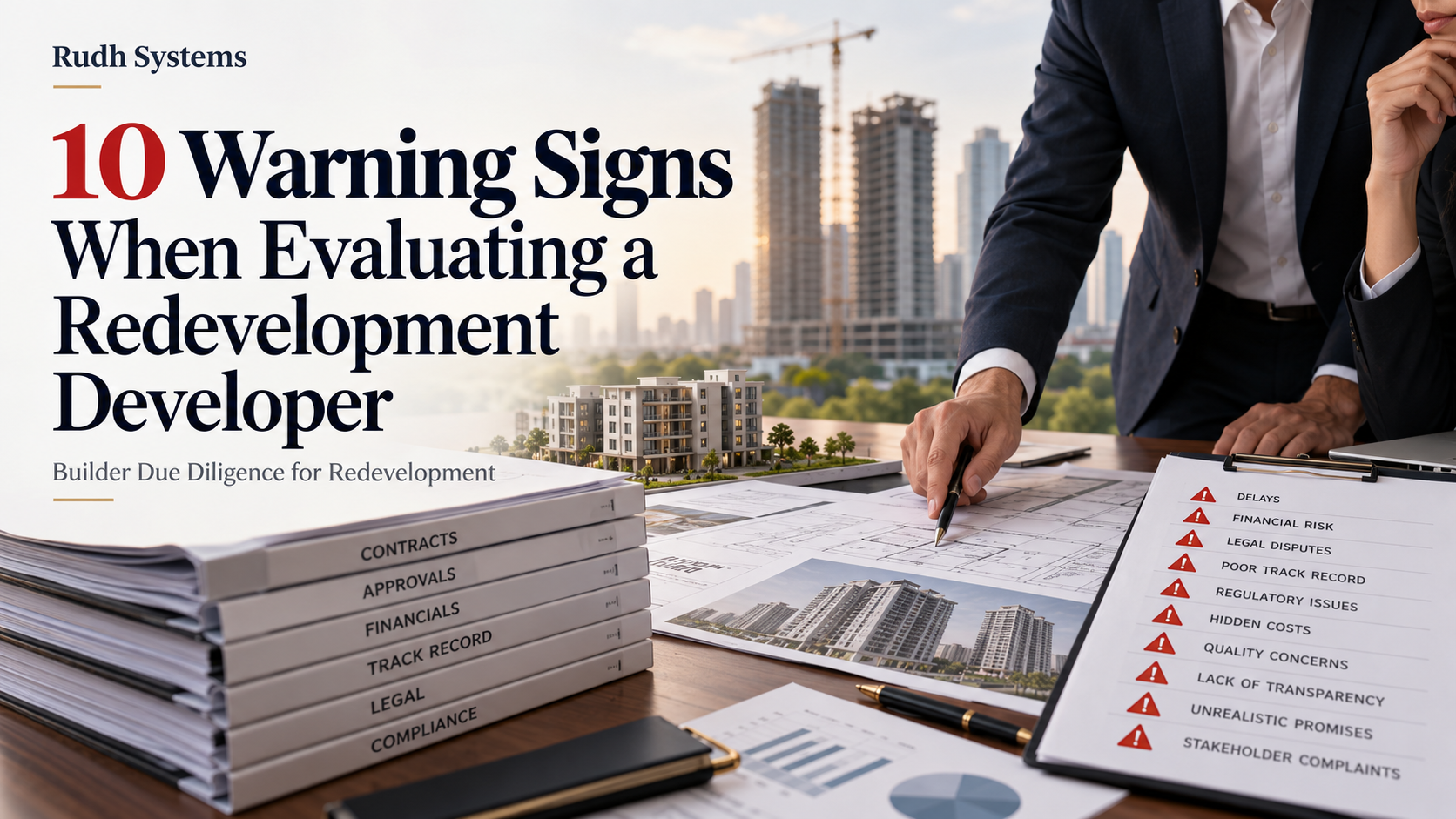
This article is the red-flag companion to How to Select a Developer for Redevelopment in India: Due Diligence Checklist. That guide explains the full evaluation process and 100-point scorecard. This one focuses only on the signals that should cause the committee, PMC, lawyer and financial adviser to investigate further before members vote.
How to use these warning signs
Do not treat this as a mechanical blacklist. A strong due-diligence process separates:
- explainable issues that can be documented and mitigated;
- material risks that require stronger contract/security terms;
- knockout risks that make appointment imprudent.
1. The offer is materially better than everyone else's—and the assumptions are unclear
The easiest way to win a redevelopment tender is to promise more: larger replacement area, higher rent, larger corpus, more amenities and a shorter completion period. The problem is that these benefits can be funded only by real development potential, real sale revenue and real capital.
Ask the PMC to identify exactly why the outlier bid is higher:
- Does it assume more FSI/FAR or TDR than the common feasibility?
- Does it assume premium sale prices that have not been stress-tested?
- Does it assume lower construction costs than comparable bidders?
- Does it postpone major premiums or approval costs?
- Does it rely on future regulation changes or adjoining-land rights?
- Does it assume rapid presales before meaningful construction?
An aggressive offer is not automatically unsafe. It becomes a red flag when the developer cannot reconcile the commercial promise with a credible project cash-flow and approvals plan.
2. The brand is strong, but the contracting entity is thin or keeps changing
Real-estate groups often use SPVs for individual projects. That is normal. The warning sign is when the society is shown the reputation and balance sheet of one group company but asked to contract with a different, thinly capitalised entity without enforceable parent support.
Check the exact legal entity using Ministry of Corporate Affairs data and corporate documents. Confirm:
- company/LLP name and CIN/LLPIN;
- incorporation date;
- directors or designated partners;
- capital and financial statements where available;
- existing charges;
- who is authorised to sign;
- whether a parent-company guarantee is offered;
- whether the same entity appears as promoter on relevant RERA projects.
A last-minute entity substitution should trigger fresh due diligence, not a routine drafting change.
3. The RERA record shows a repeated pattern of extensions, lapse, abeyance or non-compliance
RERA registration is not a quality certificate, but the authority record can reveal execution patterns. Section 4 of the central RERA Act requires promoters to disclose recent projects, current status, delays and pending cases when applying for registration. Section 11 requires continuing project updates.
For each material project, compare the original completion date with the current status. Look for repeated:
- extensions with weak explanations;
- lapsed project registrations;
- abeyance or compliance actions;
- revoked or deregistered projects;
- outdated quarterly progress reports;
- complaints involving delay, refund or possession;
- orders the promoter has not complied with.
MahaRERA, for example, publishes registered projects, project/promoter complaints, lapsed and revoked projects, abeyance lists and NCLT-project information. Other state RERA systems differ, so search the relevant authority for the developer's operating states.
4. Transit-rent promises are generous, but the funding source is vague
Members can become financially dependent on the developer the day they vacate. A high monthly rent number is only as good as the developer's ability to pay it for the full displacement period.
Calculate the total annual and project-long obligation. For example:
- monthly rent × number of members;
- plus deposit;
- plus brokerage and shifting;
- plus annual escalation;
- plus the cost of delay beyond the original completion date.
Then ask how that obligation is funded if free-sale bookings are delayed. Look for:
- developer equity committed before presales;
- ring-fenced rent reserve or direct-payment mechanism if negotiated;
- adequate project finance;
- bank guarantee/performance security;
- history of paying rent on time in comparable redevelopment projects.
5. The developer resists independent financial due diligence
Redevelopment is a long-duration credit exposure. If members vacate, they are effectively relying on the developer to fund both temporary accommodation and construction for years.
Warning signs include:
- refusal to provide audited financial statements or a reasonable financial summary;
- no project-specific sources-and-uses statement;
- large debt or charges that are not explained;
- no lender term sheet or finance strategy for a capital-intensive project;
- heavy dependence on future bookings;
- many simultaneous projects competing for the same corporate cash;
- large related-party receivables or liabilities that advisers cannot reconcile;
- claims such as “funding is fully arranged” without documentary support.
Net worth alone is not enough. The society needs to understand liquidity, leverage, cash-flow timing and the ability to survive a slower sales market.
6. The developer's insolvency or creditor history is incomplete or inconsistent
Search the exact legal entity on the Insolvency and Bankruptcy Board of India's public-announcement system and have counsel review material NCLT and court proceedings.
An insolvency petition alone is not necessarily disqualifying. The more serious warning signs are:
- admitted CIRP or liquidation proceedings;
- multiple creditor actions across group companies;
- repeated lender enforcement;
- settlements followed by new defaults;
- material proceedings omitted from the developer's disclosure;
- significant dependence on assets already under enforcement risk.
Inconsistency matters. A disclosed dispute with a written explanation is very different from a proceeding that the society discovers independently after being told there are “no material cases.”
7. The developer wants broad mortgage or assignment rights before funding is transparent
Project finance may require security. But broad clauses allowing the developer to mortgage “the property and all development rights” or transfer the project to affiliates can expose the society if the developer or lender later defaults.
The society's lawyer should identify:
- what rights can be charged;
- whether rehabilitation premises are excluded;
- whether society consent is needed;
- what lender non-disturbance protections exist;
- what release is required before member possession;
- whether a lender can replace the developer;
- whether assignment, SPV substitution or change of control requires fresh approval.
Where RERA applies, Section 15 restricts transfer or assignment of majority project rights and liabilities without specified allottee consent and Authority approval. The Development Agreement should still define broader contractual protections.
8. The approval strategy contains too many “to be confirmed later” assumptions
Redevelopment offers are only as real as the planning route supporting them. A bidder may legitimately need authority confirmation on some points. The warning sign is when key economics depend on several unresolved assumptions simultaneously.
Examples:
- additional FSI/FAR not yet validated;
- TDR pricing or availability assumed without evidence;
- adjoining land or access not secured;
- height/fire/airport restrictions unresolved;
- tenant/occupant or title issues deferred;
- premium concessions assumed but not applicable yet;
- sale-building configuration dependent on future policy changes.
The PMC should classify every major assumption as confirmed, reasonably supportable, conditional or speculative. The bid score should reflect that status.
9. Past delivery references are curated, inaccessible or inconsistent with public records
A developer should be able to provide several comparable redevelopment references. The society should independently verify them.
Warning signs include:
- only one “showcase” project is offered as a reference;
- the society/association contact is always a developer representative;
- completed-project dates differ from RERA or occupancy records;
- reference societies report late rent or unresolved defects;
- the developer claims redevelopment experience but most examples are greenfield projects;
- current sites have visibly low activity despite optimistic progress claims.
Visit completed projects and an active site. Speak directly with committee/board representatives where possible. Ask about the period after the agreement was signed, not only the sales experience.
10. The developer resists transparent governance, document access or independent review
One of the strongest behavioural warning signs appears before appointment: the developer treats reasonable due diligence as hostility.
Be cautious if the bidder:
- pushes for a rapid appointment before the PMC comparison is complete;
- asks to negotiate material terms privately with only one or two office bearers;
- objects to independent legal review;
- refuses to mark deviations from the tender or draft DA;
- discourages member access to bid comparisons or key documents;
- changes the commercial offer verbally without issuing a revised written offer;
- uses urgency—“approve this week or the offer disappears”—to shorten governance review;
- will not provide documentary responses to material due-diligence questions.
The pattern matters more than any single red flag
| Pattern | Risk level | Suggested response |
|---|---|---|
| One historical delay with clear documents and completed possession | Moderate / explainable | Verify evidence and score appropriately |
| Aggressive offer + speculative FSI assumptions | High | Recalculate bid on common feasibility |
| Thin SPV + no parent guarantee + broad mortgage rights | High | Require stronger entity/security structure or reject |
| Repeated rent complaints + weak liquidity + multiple delayed projects | Very high | Enhanced financial review; likely knockout if not cured |
| Admitted insolvency + control uncertainty | Critical | Independent legal/financial advice before any consideration |
| Material undisclosed litigation + inconsistent representations | Critical integrity issue | Consider disqualification |
Five documents that should exist before a red flag is treated as resolved
- Written developer explanation.
Not a verbal reassurance. - Independent source evidence.
RERA, MCA, IBBI, court/authority orders, lender or audited documents as relevant. - PMC/lawyer/finance adviser assessment.
The person competent to evaluate the issue should record their view. - Mitigation in the commercial or contract terms.
For example, stronger security, parent guarantee, reduced mortgage rights or specific milestones. - Decision record.
The committee/member body records why the risk was accepted or rejected.
Ten questions to ask the bidder at the final presentation
- Which part of your offer has the greatest approval risk?
- Which current project has experienced your longest delay, and why?
- Which project has required the most RERA extensions?
- How will you fund member rent if sales are delayed by 12 months?
- What exact entity will sign the Development Agreement?
- What parent/company support stands behind that entity?
- What project rights will your lender require as security?
- What bank guarantee will you provide, and when can the society invoke it?
- Which material litigation, insolvency or lender matters should members know about?
- What information are you willing to report to members every month after appointment?
Committee red-flag checklist before recommending a developer
- Exact contracting entity verified.
- RERA track record reviewed across relevant projects.
- MCA corporate and charge information checked.
- IBBI/NCLT insolvency review completed.
- Comparable redevelopment references independently contacted.
- Active construction site inspected.
- Financial capacity and project funding assessed.
- Transit-rent obligation stress-tested.
- Approval assumptions classified by PMC.
- Mortgage and assignment rights reviewed by lawyer.
- Bank guarantee/security terms agreed before appointment.
- All material litigation/non-compliance explained in writing.
- Commercial offer normalised against the same feasibility.
- Conflicts of interest declared.
- Scorecard and decision rationale preserved for members.
Keep developer due diligence visible to members
Rudh Systems can organise tender bids, RERA records, corporate checks, due-diligence findings, PMC comparisons, developer responses, meeting decisions and the final Development Agreement in one controlled redevelopment portal—so the selected developer can be evaluated against the evidence members were shown.
Frequently asked questions
What is the biggest red flag when evaluating a redevelopment developer?
A serious mismatch between the developer's offer and its demonstrated ability to fund and execute the project is one of the biggest warning signs. Extremely high carpet area, rent or corpus should be tested against planning feasibility, project finance and comparable delivery history.
Is a high number of RERA complaints enough to reject a developer?
No. Complaint count alone can mislead because larger developers have more projects and customers. Review the pattern, subject matter, final orders, repeated delay findings, refund failures, non-compliance status and whether the same issues recur across projects.
Should a society reject a developer with a RERA extension?
Not automatically. Extensions can arise for different reasons. The due-diligence issue is whether extensions are frequent, prolonged, poorly explained or accompanied by stalled work, rent defaults, lapsed registrations or adverse orders.
Why is a thin SPV a risk?
A project-specific SPV can be legitimate, but if it has little capital and no enforceable parent support, the society may be contracting with an entity that cannot independently fund rent, construction or claims. The DA should make responsibility and guarantees explicit.
Is an insolvency petition against a developer an automatic disqualification?
No. Petitions can be disputed or dismissed. The important distinction is whether proceedings have been admitted, whether there is recurring creditor stress, and whether the matter can affect control, assets or funding of the proposed redevelopment.
What if the developer refuses to share audited financials?
That is a material due-diligence concern, particularly for a project where members will vacate and depend on the developer for rent and completion. The society should obtain enough verified financial information to assess liquidity, borrowings and project funding.
Is the highest transit rent always better?
No. Rent is valuable only if it can be paid throughout the displacement period. Compare total rent obligation, escalation, advance period, funding source, payment security and the developer's history of paying rent on time.
Why is broad mortgage permission dangerous?
If the DA permits wide mortgage or security rights without rehabilitation protections, lender enforcement can create conflicts with society/member interests. The society should understand what can be charged, lender rights and the release mechanism.
What should trigger enhanced due diligence rather than immediate rejection?
One unusual item—such as a delayed project, a litigation matter or a change in funding—may simply require explanation and documents. Multiple connected warning signs, inconsistent disclosures or refusal to provide evidence are more serious.
How should warning signs be documented?
Record each red flag, source, developer explanation, supporting evidence, adviser assessment, mitigation and final committee/member decision. This creates an auditable selection record rather than an informal impression.
Official sources for red-flag checks
- India Code — Real Estate (Regulation and Development) Act, 2016, especially Sections 4, 11, 14, 15 and 18.
- MahaRERA — project registration and promoter/project compliance resources, including complaints, lapsed/revoked projects, abeyance lists and NCLT projects.
- Ministry of Corporate Affairs — MCA portal for Company/LLP Master Data and public corporate documents.
- Insolvency and Bankruptcy Board of India — Public Announcements.
- Rudh Systems — How to Select a Developer for Redevelopment in India.
- Rudh Systems — Building the Right Redevelopment Record System.