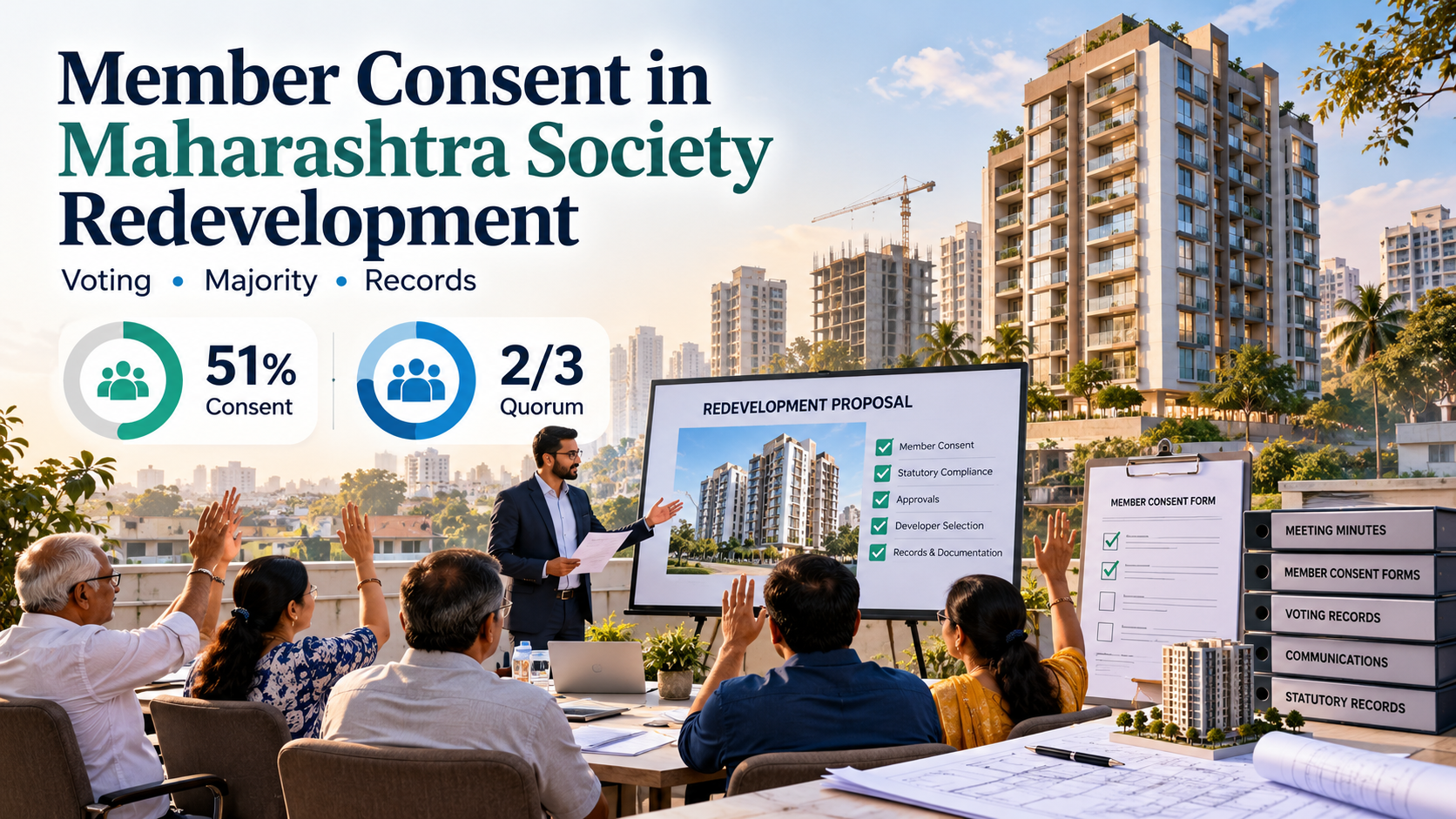
This is a focused voting-and-records guide. Read Society Redevelopment Rules in Maharashtra for broader context and How to Select a Redevelopment Developer for bid evaluation. This article does not claim that a particular digital portal is legally required to certify a vote.
What changed on 30 September 2026?
The Cooperation Department's new redevelopment Government Order of 30 September 2026 (order SGRYO-2026/Pr.Kr.108/14-S, government reference 202609301657141847) supersedes the Government Resolution dated 4 July 2019 and subsequent circulars under it. It covers developer-led redevelopment, self-redevelopment, group redevelopment and relevant contractor selection.
The headline percentage remained 51% of total membership for the preliminary redevelopment decision, but the updated directions put renewed emphasis on elected committee authority, physical attendance, eligible video participation, recorded selection meetings, transparent bidding and inspection of the evidence behind decisions.
What does the 51% redevelopment consent percentage mean?
The revised framework requires approval from not less than 51% of the society's total members for the preliminary redevelopment decision. It does not mean 51% of whichever members happen to attend, and it is not the same as a two-thirds affirmative vote.
| Total society members | At least two-thirds quorum* | At least 51% affirmative votes* | At least 51% physically present* |
|---|---|---|---|
| 40 | 27 | 21 | 21 |
| 60 | 40 | 31 | 31 |
| 100 | 67 | 51 | 51 |
| 101 | 68 | 52 | 52 |
| 150 | 100 | 77 | 77 |
*Illustrative thresholds calculated by rounding fractional minimum counts up. These examples concern the described September 2026 SGM procedure; check the signed order, society register, applicable bye-laws and any project-specific court directions before conducting an actual vote.
Example: A society has 100 members. A two-thirds quorum means at least 67 valid attendees. Under the reported 2026 physical-presence safeguard, at least 51 members must attend in person. The decision still needs at least 51 valid approvals measured against all 100 members. If only 45 vote yes—even if that is the majority of those in the meeting—the total-membership threshold is not met.
Quorum, voting majority and written consent are three different records
Quorum is the minimum participation required to conduct specified SGM business. An affirmative majority is the number of valid votes supporting the particular resolution. Written consent is an identifiable member's documentary confirmation of support where required by the redevelopment procedure.
- Attendance register: who was physically present, when and in what membership capacity.
- Remote attendance register: identity verification, reason/category where required, connection details and participation evidence.
- Vote tally: yes/no/abstain for the exact resolution, counted against the total eligible membership.
- Written consents: signed forms from supporting members where prescribed, cross-referenced to the vote register.
Never substitute a sheet of signatures for a documented SGM vote, or treat an unsigned attendance count as proof that the member voted in favour.
Can members abroad or unable to attend vote by video conference?
Reporting on the 2026 order says remote attendance is permitted for members abroad and certain members who are seriously ill, disabled or unable to attend for unavoidable reasons. Such participation can count towards the meeting's two-thirds quorum and 51% vote total.
However, the same order has been reported to require at least 51% of total society membership physically present. This means an online-attendance option does not eliminate the in-person floor. This feature has attracted public criticism, which illustrates why a society should not build its voting system on the old assumption that any mix of online attendance is sufficient.
Who may initiate redevelopment and convene the SGM?
Under the revised process, an eligible, lawfully elected managing committee should coordinate the process; a Registrar-appointed administrator or authorised officer should not independently make the redevelopment decision on the society's behalf. Where the required member petition triggers a meeting, the committee should log the original signed request and track the statutory notice and meeting deadlines.
Contemporary reporting describes an application by at least one-fifth of members initiating the meeting process, with the committee registering the request and convening the SGM within the prescribed period. It also reports notice of at least 14 days for the relevant agenda. A member-facing system should retain the petition, receipt date, meeting notice, delivery acknowledgements, agenda and versions of supporting reports.
If quorum fails, the revised framework describes an adjournment/reconvening procedure and a cooling-off period if quorum again fails. The precise notice intervals and any exception must be checked against the original order, rather than copying an old 2019 template without review.
Is developer selection a separate vote?
Yes. The initial decision to explore or undertake redevelopment and the subsequent selection of a specific developer are distinct decision points. The 2026 framework continues to place the developer-selection vote in an SGM and strengthens its oversight: published reporting identifies a Registrar-appointed authorised officer at the developer-selection meeting, video recording, a transparent tender comparison and the 51%-of-total-membership approval standard.
Review the shortlist and the developer due diligence checklist before the vote. The final developer offer, comparison matrix and all material negotiated changes should be accessible to members—not presented for the first time after the winner is announced.
For a candidate to be validly chosen, the committee should track how many valid votes each bidder received and whether the chosen bidder reached the required affirmative threshold. If none does, obtain legal/Registrar guidance on the next procedurally valid step rather than selecting the largest plurality by assumption.
Show of hands, secret ballot and the voting evidence
Reported 2026 procedures contemplate a show of hands and a secret-ballot option when the specified fraction of members demands it. A society should confirm the trigger and form in the original GR, ensure members are told the voting method in advance and preserve the method actually used.
For a secret ballot, maintain an independently supervised ballot-issue register, eligibility validation, sealed/secure tally, reconciliation of ballot numbers and certified results. The member-level vote choices should not be exposed to other members where ballot secrecy applies, while the total votes, decision and methodology remain auditable. For an open vote, preserve the appropriately authorised voting list and minutes.
Do not mix up society majority with the RERA two-thirds rule
Three different legal frameworks are frequently confused:
| Question | Relevant framework | What it decides |
|---|---|---|
| May this Maharashtra cooperative society resolve to redevelop? | Applicable society law, bye-laws and 30 September 2026 Section 79A directions | Society decision process and voting / quorum |
| May a promoter change specified sanctioned plans or common areas in a registered project? | RERA Section 14 (where applicable) | Separate allottee-consent protections |
| May an apartment-ownership property redevelop? | Relevant state apartment ownership law, declaration/deeds and bye-laws | May have a different consent and property-rights test |
RERA's two-thirds allottee consent requirement for certain plan changes under Section 14 and project-rights transfers under Section 15 is not the redevelopment SGM quorum. Read RERA and Redevelopment Projects in India and Society vs RWA vs Apartment Association for the distinctions.
Build a master membership and voting register before issuing notice
The percentage is only as reliable as the denominator. Create a dated member register showing membership number, name, flat identifier, status, voting eligibility, joint-holder representation, succession disputes, authorised representatives and supporting society records. Get the independent lawyer or competent officer to resolve ambiguity before counting the votes.
Maintain a fixed snapshot identifying the membership population used for the particular SGM and its approval calculation. Log any corrections with the reason, supporting document, reviewer and timestamp. Do not edit the denominator after the meeting merely to make the result exceed 51%.
The minimum documentary trail every society should preserve
| Document / record | Evidence to preserve |
|---|---|
| Member application | Signed request, receipt date, member eligibility and committee acknowledgement |
| SGM notice and agenda | Final approved notice, service dates, recipients and proof of delivery |
| Membership snapshot | Total eligible members, legal review, locked version and corrections |
| Attendance | In-person signatures plus separately verified remote participants |
| Vote results | Exact resolution, votes for/against/abstaining, counting method and certification |
| Written support | Signed consents from those required to provide them; cross-match to votes |
| Audio/video evidence | Recording of relevant meeting, identity-safe storage and authorised viewing |
| Objections and replies | Dated submissions, clarifications, decisions and communication trail |
| PMC and developer selection | Quotations, tender advertisements, bids, comparative statement, Registrar officer presence |
| Minutes and circulation | Signed minutes, decisions, distribution and acknowledgements |
Contemporary reporting on the 2026 directions describes open member inspection of redevelopment documentation and video records, with prescribed copy charges possible. Project transparency should be implemented alongside sensible privacy and access controls for bank details, personal identity papers and other sensitive material.
What if a member disagrees or refuses to sign?
A member's objection must be recorded and addressed. A redevelopment vote is a collective governance decision, but it does not erase individual title, agreement, due-process or court-order rights. Do not label every dissenting member an obstructionist or assume the society can forcibly take possession solely because 51% approved a resolution.
Keep the dated objection, response, relevant resolution, legal opinion, executed agreements and any judicial direction together. If ownership is disputed, or a member challenges the procedure, obtain project-specific legal advice before using the vote as an eviction instruction.
How a redevelopment member portal should handle consent
A redevelopment record management system should make approvals auditable without turning the portal into an unauthorised voting authority. Useful modules include:
- verified member register and version history;
- SGM notices with acknowledgement status;
- meeting attendance separated into physical and eligible remote participation;
- resolution-specific voting threshold and arithmetic;
- consent-document collection with secure individual access;
- meeting minutes and controlled video recording;
- PMC reports, developer bids and comparative charts;
- legal exceptions and disputes register;
- auditable permission roles and exportable records.
The portal should publish the relevant decisions and their supporting documents to authorised members, while leaving the legal validity of votes to the society's governing process and professional advisers.
Keep member consent and redevelopment decisions traceable
Rudh Systems provides a controlled redevelopment member portal for SGM notices, minutes, attendance evidence, consent documents, PMC reports, developer comparison records, approval updates and member communication—with role-based access and document history.
Frequently asked questions
What percentage of members must consent to redevelopment in Maharashtra?
Under the 30 September 2026 cooperative housing society redevelopment directions, the preliminary decision is reported to require at least 51% of all society members voting in favour. Confirm the eligible membership register and exact requirement in the signed order.
Does 51% refer to members present?
No. The relevant threshold is based on total society membership, not merely those who attended the SGM.
Is two-thirds consent necessary to start society redevelopment?
The revised framework reports a two-thirds quorum for specified redevelopment SGMs. Quorum is an attendance threshold, not an automatic requirement that two-thirds vote in favour. The affirmative redevelopment threshold is 51% of total membership.
Can online members attend and vote?
The September 2026 order permits specified categories of remote participants to count toward quorum and majority, according to contemporary reports, but also requires at least 51% of total society membership to be physically present.
Are written consent letters required after the SGM vote?
The 2026 directions retain written-support documentation for members backing redevelopment as reported in the revised framework. The society should check the signed GR and the specific voting stage for the prescribed form and retention.
Can the committee decide redevelopment without a general-body vote?
The current cooperative housing society framework places material redevelopment decisions with the member meeting and requires a lawfully elected committee to coordinate the process. A committee-only decision is not a substitute for the SGM required under the applicable procedure.
Does the 51% rule also apply to an RWA or apartment association?
Not automatically. The governing state apartment-ownership or other property law and the entity's documents can impose different consent rules.
Does RERA's two-thirds consent override society approval?
No. RERA Sections 14 and 15 govern specific registered-project allottee-consent situations. They are separate from the cooperative society's general-body redevelopment decision and quorum.
What if the quorum fails?
The 2026 directions provide a reconvening procedure and a waiting period if quorum repeatedly fails. Consult the signed order for the exact deadlines and whether special project circumstances change the process.
What records prove that the majority was achieved?
A locked membership register, correct SGM notice, authenticated attendance by category, a resolution-specific vote tally, written consent evidence where required, signed minutes and preserved meeting video/ballot records provide the essential audit trail.
Sources and legal verification
- Government of Maharashtra — Government Resolution search portal. Search government document code 202609301657141847, order dated 30 September 2026, SGRYO-2026/Pr.Kr.108/14-S. This is the controlling document to verify for live legal use.
- The Indian Express (3 October 2026) — revised member-consent, meeting and tender procedure.
- Loksatta (30 September 2026) — quorum, voting and physical/remote participation language.
- The Indian Express (1 October 2026) — 2026 order superseding the July 2019 resolution.
- India Code — Real Estate (Regulation and Development) Act, 2016, especially Sections 14 and 15, separate from society redevelopment SGM rules.